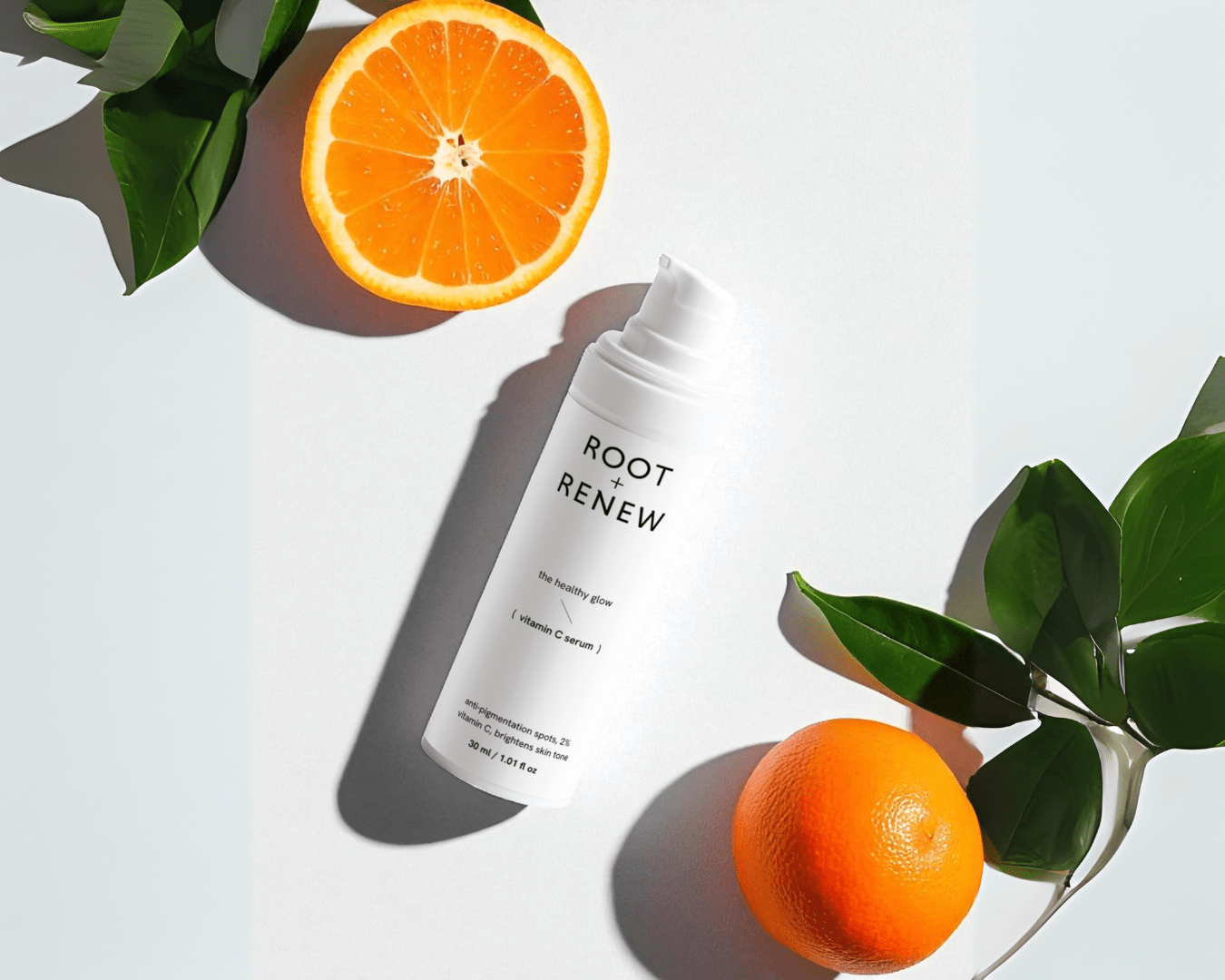


Vitamin C is one of the better-studied antioxidant ingredients in topical skincare, but it is often marketed with more certainty than the clinical evidence supports. A well-formulated vitamin C product may help improve the appearance of uneven tone and photoaging and can contribute antioxidant activity. The result depends on the form of vitamin C, the finished formula, stability, concentration, packaging, and consistent use.
Vitamin C is not mandatory for healthy skin, it does not replace sunscreen, and there is no universal concentration that is automatically best for everyone.
What Does Topical Vitamin C Do?
Vitamin C has several roles relevant to skin. Research supports its antioxidant activity and biological role in collagen synthesis, and clinical studies suggest topical formulas can improve some measures of pigmentation and photoaging. At the same time, reviews note that the number and quality of clinical trials remain limited and that formulation is a major challenge.
In practical skincare terms, vitamin C is most often used for:
- antioxidant support
- the appearance of dull or uneven tone
- some forms of visible hyperpigmentation
- supporting a routine focused on visible signs of photoaging
Those are more defensible goals than promising that one serum will “transform” every skin type.
Does Vitamin C Brighten Skin?
Vitamin C can influence melanin-related pathways, and clinical studies have reported improvements in pigmentation with some topical formulations. A 2023 systematic review found improvement in pigmentation and photoaging outcomes in the small group of qualifying studies, while also concluding that more research is needed and that noticeable changes may require longer-term use.
If discoloration is your main concern, sun protection remains important because ongoing UV exposure can work against any brightening routine.
Does Vitamin C Boost Collagen?
Vitamin C is required for normal collagen synthesis, and topical vitamin C has biological rationale for supporting collagen-related processes. But that does not mean every serum produces the same visible change in firmness or wrinkles. Delivery to the skin and formulation stability matter.
It is more accurate to treat vitamin C as one evidence-supported option within a broader photoaging routine than as a guaranteed collagen treatment.
Is Vitamin C Photoprotective?
Vitamin C has antioxidant activity that can complement a daytime routine, but it is not sunscreen. It does not create a labeled SPF and should never be used as a substitute for broad-spectrum sun protection.
If you like vitamin C in the morning, apply it before moisturizer and sunscreen according to the directions for your product. Morning use is common because antioxidant skincare fits naturally into a daytime routine, but vitamin C can also be used at night if the formula and your skin tolerate it.
What Percentage of Vitamin C Is Best?
There is no single percentage that can be recommended across every vitamin C product. “Vitamin C” can refer to L-ascorbic acid or a variety of derivatives, and concentration cannot be separated from pH, vehicle, stability, and delivery.
The common claim that everyone needs a 10–20% serum is too simplistic. Higher concentration does not automatically mean better results and may increase irritation with some formulas. Follow the finished product’s directions rather than shopping by percentage alone.
L-Ascorbic Acid vs. Vitamin C Derivatives
L-ascorbic acid is one of the most studied forms of topical vitamin C, but it is chemically unstable and formulation can be challenging. Vitamin C derivatives are used to improve stability or cosmetic feel, but they are not all interchangeable and the evidence for each derivative differs.
This is why a label that simply says “vitamin C” does not tell you everything you need to know about performance.
How to Choose a Vitamin C Serum
- Look at the complete formula. Do not judge only by percentage or one headline ingredient.
- Consider packaging and storage instructions. Some vitamin C forms are sensitive to light, air, or heat. Follow the manufacturer’s directions.
- Choose a texture you will use consistently. A theoretically impressive formula is not useful if it irritates your skin or sits unused.
- Start conservatively if you are reactive. Patch testing and gradual introduction can make it easier to identify irritation.
For more on storing vitamin C and other formulas, see our skincare storage guide.
Where The Healthy Glow Fits
The Healthy Glow is Root + Renew’s vitamin C serum. It is the targeted antioxidant and brightening option in the range for people who want vitamin C in a streamlined routine.
You do not need to combine it with every other serum. Choose the targeted product that best matches your current goal.
If antioxidant support and brighter-looking tone are your priorities, you can select The Healthy Glow when you build your Root + Renew routine.
Vitamin C vs. Peptides
Vitamin C and peptides are different ingredient categories. Vitamin C has a clearer antioxidant and pigmentation-focused role, while peptides are a broad family used in products aimed at hydration, smoothness, firmness, and other cosmetic goals depending on the peptide.
If you are deciding between them, see our Peptides vs. Vitamin C guide.
Vitamin C vs. Niacinamide
These ingredients are not universal substitutes for one another and they do not need to be treated as incompatible. Niacinamide has evidence for several cosmetic uses including pigmentation and barrier-related outcomes, while vitamin C is commonly chosen for antioxidant support and uneven-looking tone.
Read our Vitamin C vs. Niacinamide guide for a direct comparison.
Can Sensitive Skin Use Vitamin C?
Some people tolerate vitamin C well and others experience stinging, redness, or dryness, especially with acidic L-ascorbic acid formulations. “Sensitive skin” is also not one uniform diagnosis.
If you are reactive, introduce one new product at a time and stop if you develop persistent irritation. A lower-irritation routine may be more important than forcing vitamin C into it.
Common Vitamin C Myths
“Vitamin C is essential for every skincare routine.”
No. Sunscreen, appropriate cleansing, and moisturizer are more foundational. Vitamin C is an optional targeted step.
“20% is always better than 10%.”
No. Formula design and tolerance matter, and the ideal concentration has not been established across all topical vitamin C products.
“Vitamin C replaces SPF because it protects against UV.”
No. Antioxidant support and sunscreen are different functions.
“If a vitamin C serum tingles, it is working.”
Tingling is not an efficacy test. Persistent burning or irritation is a reason to stop and reassess.
“Vitamin C only works in the morning.”
No. Morning use is convenient for pairing with sunscreen, but a well-tolerated product can also be used at night.
A Simple Vitamin C Routine
Morning
- Cleanse if needed.
- Apply vitamin C according to the product instructions.
- Use moisturizer if your skin needs it.
- Finish with broad-spectrum sunscreen.
Evening
You do not need another vitamin C application unless the product directions and your routine call for it. Cleanse, use the targeted or hydrating step you have chosen, and moisturize as needed.
The Bottom Line
Vitamin C is a legitimate skincare ingredient with useful antioxidant and pigmentation-related evidence, but its performance depends heavily on the finished formula. It is not universally essential, higher percentages are not automatically better, and it does not replace sunscreen.
If brightness and uneven-looking tone are priorities, vitamin C can be a sensible targeted serum. If another concern matters more, choose the ingredient that matches that goal instead of adding more steps by default.